
Best electric toothbrush in 2026: what dentists actually recommend
A science-backed, hype-free guide to choosing the right electronic toothbrush for your mouth — and your budget.
You brush every day. Are you doing it right?
Here’s something most people don’t realize until a dentist points it out: it’s not how often you brush that matters most — it’s how well. And this is exactly where an electronic toothbrush earns its keep. The motor does the work of breaking up plaque; you just have to show up and move it around your mouth.
But walk into any pharmacy and you’ll face a wall of buzzing options from $15 to $500. Do you need AI-powered gum mapping? Is sonic better than oscillating? Does a built-in timer actually change your habits? After digging through clinical research and expert reviews, here’s a clear-eyed breakdown of what genuinely matters — and what you can safely ignore.
Sonic vs. oscillating: the debate that actually has an answer
The two dominant technologies in electric toothbrushes — sonic (Philips Sonicare’s approach) and oscillating-rotating (Oral-B’s signature) — have been pitted against each other in dozens of clinical trials. The verdict, while nuanced, leans in one direction.
Oscillating-rotating brushes use a small round head that spins clockwise and counterclockwise, physically wrapping around each tooth surface. Sonic brushes vibrate laterally at extremely high frequencies (Philips claims up to 31,000 strokes per minute), with the secondary benefit of fluid dynamics disrupting plaque slightly beyond the bristle contact zone.
A 2025 randomized controlled trial published in the Journal of the American Dental Association found that oscillating-rotating brushes showed advantages for both plaque removal and gingivitis control compared to sonic models. This aligns with a broader meta-analysis covering 21 gingivitis studies and 25 plaque studies conducted between 2007 and 2022.
The three features dentists say actually move the needle
2-minute timer + pacer
Most people brush for under 45 seconds. A timer with a 30-second quadrant pacer is the single cheapest upgrade for your oral health. Non-negotiable.
Pressure sensor
Brushing too hard erodes enamel and recedes gums — irreversibly. A sensor that slows or alerts you when you push too hard is especially valuable if you’ve ever been told you’re an aggressive brusher.
Battery life
Matters less at home, a lot more when traveling. Most brushes in the $40–$80 range last 2–3 weeks per charge. Premium models can reach 60+ days, which is genuinely useful.
Importantly, experts at Electric Teeth — one of the most thoroughly tested independent review sources — note that spending beyond the $40–$80 range buys you travel cases, better app connectivity, and improved design, but not meaningfully better cleaning. The core cleaning technology plateaus earlier than the prices do.
Top electronic toothbrush picks for 2026
Here are the models that consistently rise to the top across independent testing, dental expert endorsements, and real-world long-term use.
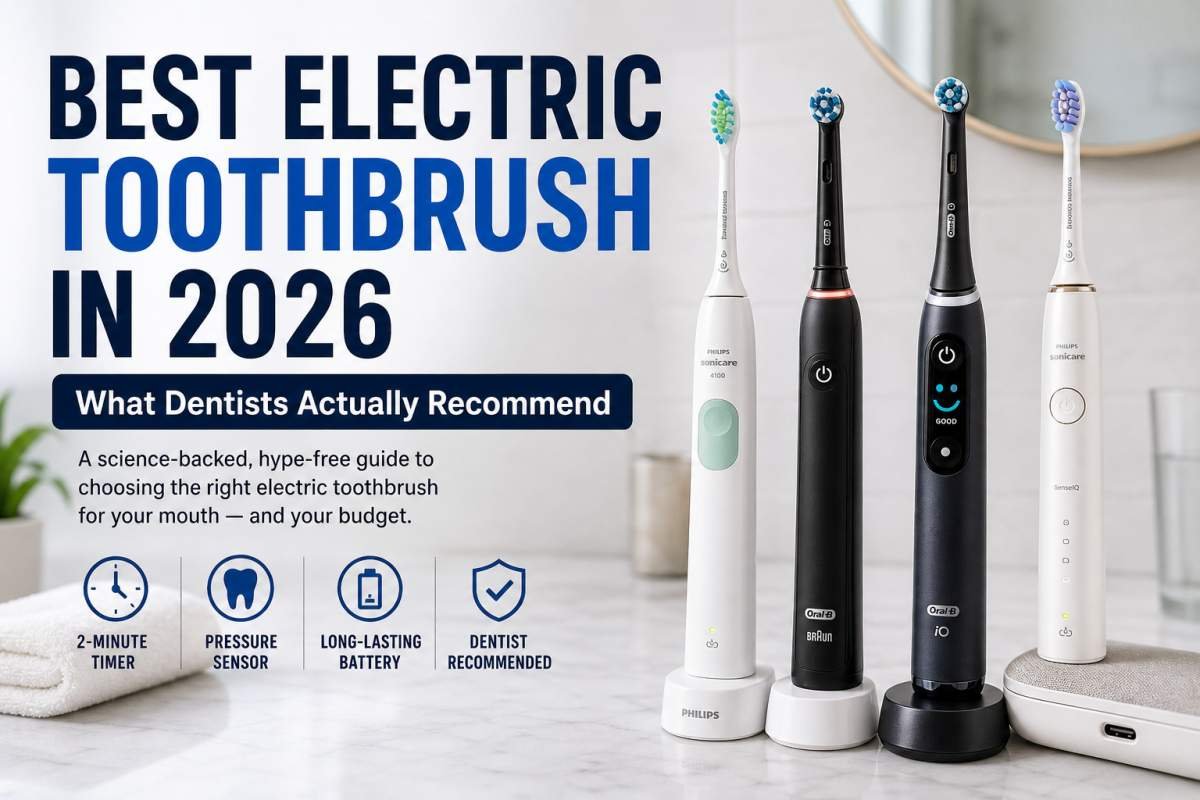
| Best overall Philips Sonicare 4100 Series ~$40–$50 Top pick for most people | Best premium Philips Sonicare 9900 Prestige ~$300–$330 Frequent traveler’s choice | Best oscillating Oral-B Pro 1000 ~$50–$70 Dentist office favorite | Best smart Oral-B iO Series 9 ~$230–$250 AI position detection |
| Model | Tech | Timer | Pressure sensor | Battery | App |
|---|---|---|---|---|---|
| Sonicare 4100 Best value | Sonic | ✓ 2 min | ✓ Vibration | ~14 days | — |
| Oral-B Pro 1000 ADA accepted | Oscillating | ✓ 2 min | ✓ Visual | ~7 days | — |
| Oral-B iO Series 9 Smart | Oscillating+ | ✓ 2 min | ✓ Color display | ~14 days | ✓ AI tracking |
| Sonicare 9900 Prestige Premium | Sonic | ✓ 2 min | ✓ SenseIQ | ~60 days | ✓ SenseIQ app |
Philips Sonicare 4100 — the best electric toothbrush for most people
At around $40–$50, the Sonicare 4100 includes a 2-minute timer, a 30-second quadrant pacer, and a vibrating pressure sensor — the full trifecta of features dentists recommend. It’s quiet, gentle on sensitive gums, and reliable enough to last years. If you’re upgrading from a manual brush, this is the most impactful upgrade per dollar you’ll find.
Oral-B Pro 1000 — the oscillating workhorse
Dentist practices favor the Oral-B Pro 1000 because its round, oscillating-rotating head mechanically wraps each tooth surface in a way that closely mimics the technique a hygienist uses. It’s ADA-accepted, has a clear visual pressure sensor, and the replacement heads cost under $10 each. One dentist writing for Stone Creek Village Dentistry calls it their “go-to recommendation for most patients.”
Oral-B iO Series 9 — for the data-driven brusher
The iO Series 9 pairs oscillating-rotating motion with micro-vibrations (Oral-B’s Magnetic Drive System) and a color LED display that scores each brushing session in real time. The companion app maps your coverage zone by zone using AI position detection. Clinical research published in PubMed found that the iO platform removed more plaque and improved gingival health faster than a comparable sonic brush over 24 weeks. If feedback loops motivate you, this is the brush that will genuinely change your habits.
Philips Sonicare 9900 Prestige — the premium daily driver
The 9900 Prestige is for people who want the complete package: 60 days of battery life, a USB-C charging travel case that also charges the brush, whisper-quiet SenseIQ adaptive technology, and an elegant design that looks at home on a marble bathroom shelf. Reviewers at Electric Teeth call it “the more complete offering” for premium buyers — though they’re candid that it won’t clean your teeth measurably better than the $50 Sonicare 4100.
What smart features are actually worth paying for?
The latest electric toothbrush models offer smartphone connectivity, AI brushing maps, and real-time pressure feedback through apps. It sounds like overkill — but there’s a genuine case for it.
The issue with brushing isn’t usually effort, it’s blind spots. Most people consistently under-clean the back molars and the inner surfaces of lower teeth. An app that maps your mouth and shows you which zones you missed for the third day in a row is genuinely corrective in a way that a timer alone isn’t.
That said, smart features only pay off if you use the app regularly. If you know you’ll charge it twice and forget it, skip them and put that $200 toward your dentist visit copay.
Special considerations: braces, sensitive gums, kids
Braces
Both oscillating-rotating and sonic brushes work well with braces, but Oral-B makes a dedicated orthodontic brush head for their iO and Pro lines that physically cups around brackets. A 2021 clinical study in PMC found the oscillating-rotating brush with an orthodontic head removed significantly more plaque in braces wearers than a sonic brush.
Sensitive gums
Sonic brushes tend to feel gentler because the vibration is lateral rather than rotational. The Sonicare 4100’s “Sensitive” mode is a reliable starting point. If you’ve been diagnosed with gum recession, a pressure sensor is essential — look for one that physically slows the brush head rather than just lighting up an LED.
Kids
Both Oral-B and Sonicare make child-specific models with smaller heads, softer bristles, and sometimes fun timer apps. The brushing fundamentals (2-minute timer, pressure sensor) matter just as much for children — arguably more, since habits formed early are hard to break.
How to make any electric toothbrush work better
The brush is only part of the equation. Prosthodontist Dr. Samantha Rawdin’s advice for patients applies universally: trust the motor. With an electric brush, you don’t scrub — you guide. Let the head do the rotation or vibration while you slowly move it across each tooth surface at a slight angle toward the gumline. Fighting the motor with a back-and-forth scrubbing motion is the single most common mistake electric brush users make.
Replace brush heads every three months (or sooner if the bristles visibly splay). Keep to a consistent routine — twice daily, two minutes — and the specific model you choose will matter far less than the habit itself.